Why We Board Our Own Work
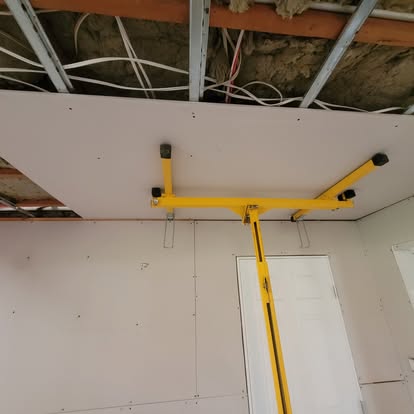
Every few months someone asks me the same thing. “Can I hang the board myself and just have you come tape it?”
I get why. Hanging drywall looks like the easy part. Cut a sheet, screw it to the studs, move on. Taping and finishing is the part that looks like a trade. So why not save some money on the labour and let us handle the finish?
The short answer is that we don’t take those jobs. Not because we’re precious about it. Because the finish is only as good as the boarding under it, and I’m the one whose name goes on the finish.
The finish starts with the board
Taping doesn’t fix boarding. It covers it.
A tight, flat, properly fastened wall takes a normal amount of mud and sands out clean. A wall with gaps at the joints, screws sunk through the paper, sheets that don’t land on a stud, or butt joints stacked where they shouldn’t be, that wall takes two or three times the mud to hide. And “hide” is the right word. It’s still under there.
Here’s what I’m looking at when I hang a sheet:
- Where the joints land. Tapered edges meet tapered edges. Butt joints get staggered and placed where the light won’t catch them.
- Screw depth. Just below the surface, paper intact. Too deep and the screw has nothing to hold. Too shallow and it telegraphs through the paint.
- Screw spacing. There’s a pattern for a reason. Miss it and the board moves, and moving board cracks tape.
- Gaps. A quarter inch here and there adds up to a wall that’s never quite flat.
- Ceilings first, then walls, so the wall sheets carry the edge of the ceiling.
- Outside corners, window returns, and anything that’s going to get bumped for the next twenty years.
None of that is complicated. All of it is the difference between a wall you never think about again and a wall you notice every time the afternoon sun comes through the window.
Where the extra mud comes from
Two things in particular make taping work that nobody needed.
Cutout plugs. When the hole around an outlet or a box gets cut sloppy and the plug goes back in loose or sitting proud, that isn’t a quick patch. That’s a taped repair sitting in the middle of a flat wall, and it shows. Missed screws do the same thing from the other direction. A screw that never went in means the board can move, and board that moves cracks tape.
Then there’s sheet length. Eight foot sheets have their place. Tight rooms, closets, stairwells, anywhere you can’t get a twelve up and around. But reaching for them everywhere because they’re easier to carry is how you end up with a wall full of joints. And the butt joints are the real problem. An eight foot butt joint is impossible to hide. You’re floating it out three or four feet either side just to keep the light off it, and that’s mud and sanding somebody is paying for.
When something goes wrong, who owns it?
This is the real reason.
Say you hang the board and we tape it. Six months later there’s a crack running along a ceiling joint. Was that the taping? Or was it a sheet that wasn’t screwed off on one edge and moved when the house dried out over winter?
I can’t tell you. And I’m not going to guess and then argue with you about it in your living room. If I board the wall and I finish the wall, there’s no argument. If it cracks, it’s mine, and I come fix it.
That’s what standing behind the work actually means. It’s easy to say. It only works if you control the whole thing.
What it actually costs you
People assume boarding it themselves saves a lot. It usually doesn’t.
Boarding is the fast part for a crew that does it every day. Sheets go up quick when you’ve got the right lift, the right screws, and you’ve done it a thousand times. The savings on that labour is real but smaller than people expect.
Then look at the other side. A homeowner boarding a room over a couple of weekends, renting a lift or fighting sheets onto a ceiling by hand, buying screws and blades and a jab saw. Plus the extra mud and sanding on our end to fix what didn’t go right, which you’re paying for either way.
Most of the time it’s close to a wash on money. And you’ve spent your weekends on it.
What we do instead
If you’ve got a room framed and ready, we board it, tape it, and finish it as one job. You get one price, one crew, and one person to call if anything isn’t right.
If you’re set on doing the drywall yourself, I’d still rather you do it well. That’s why we offer a homeowner consultation. You show me the room, I walk you through the layout, the fasteners, and the spots that trip people up, and you go do it with a plan.
Either way, the wall gets done right. That’s the only part I’m stubborn about.